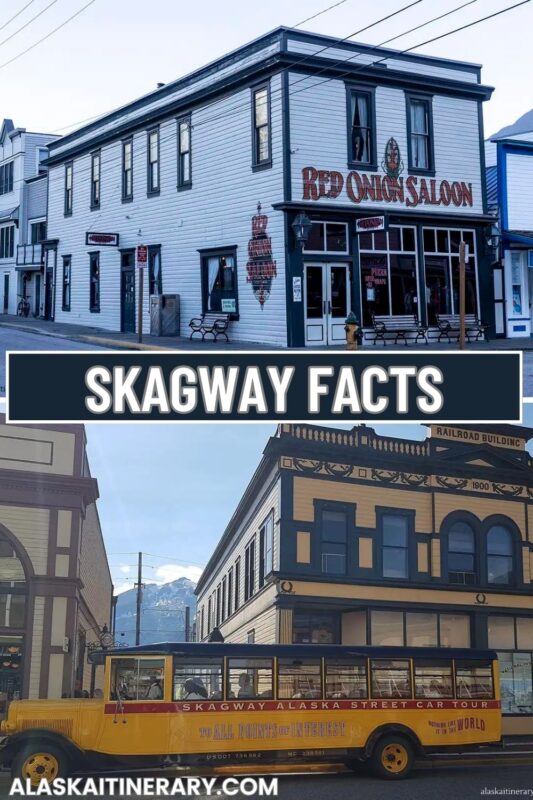
Skagway, Alaska Facts: Population, History & Fun Facts

Skagway is a small Southeast Alaska community with an outsized place in Alaska history. Only 1,104 people live in Skagway Municipality today, yet more than one million visitors come here each year. Its story is closely tied to the Klondike Gold Rush, the White Pass, and the famous railway that connected the coast with the Yukon. In this guide, we share the most interesting Skagway facts, including its current population, name meaning, Gold Rush history, location, and several fun facts that make this tiny Alaska town so unusual.
This article may contain affiliate / compensated links. For full information, please see our disclaimer here.
Our Experience Exploring Skagway
We have visited Skagway several times and explored it in very different ways.
We first experienced Skagway during our Alaska cruises, when we had only one port day to explore. Later, we returned during our almost year-long RV trip through Alaska and Canada, driving to Skagway from Whitehorse via the South Klondike Highway after traveling the Alaska Highway.
We have also reached Skagway from Haines by fast ferry, which gave us another perspective on how connected this small town is to the rest of Southeast Alaska and Yukon.
I have always loved history and learning more about the places we visit. Skagway is especially fascinating because so much of its Gold Rush past is still visible today in its buildings, museums, railway, and historic sites.
Over the years, we have explored historic downtown, Gold Rush sites, the White Pass area, nearby trails, and the roads beyond town.
That firsthand experience, combined with my love of history, is why I find Skagway so interesting. It may be small today, but its location and role in the Klondike Gold Rush make it one of the most distinctive communities in Alaska.
After so many visits, we know Skagway well, including where to stay, where to eat, and how to make the most of your time here. If you are planning a trip, check out our detailed Skagway travel guide for practical tips and our favorite things to do.


Skagway Facts at a Glance
Here are some of the most important facts about Skagway before we explore its history in more detail.
| Skagway Fact | Quick Answer |
|---|---|
| Location | Southeast Alaska, at the northern end of Lynn Canal |
| Population | 1,104 residents according to the U.S. Census Bureau’s 2025 estimate |
| Municipality size | About 434 square miles of land |
| Gold Rush boom | 1897–1898 |
| Incorporated | 1900 |
| Historic significance | Major gateway to the Klondike goldfields |
| National park | Klondike Gold Rush National Historical Park |
| Famous railway | White Pass & Yukon Route |
| Road access | Connected to Yukon by the South Klondike Highway |
| Name origin | Derived from a Lingít place name; English translations vary |
| Cruise visitors | More than 1 million cruise passengers each year |
| Known for | Klondike Gold Rush history, White Pass Railway, historic downtown, and access to Yukon |
One of the most surprising Skagway facts is the contrast between its year-round population and the number of people who visit.
Only about 1,100 people live here year-round, yet more than one million cruise passengers arrive during the busy cruise season. If you will be one of those cruise visitors, see our One Day in Skagway itinerary for cruise passengers to plan your port day step by step.
What Is Skagway Known For?
Skagway is best known for its Klondike Gold Rush history. In 1897 and 1898, thousands of stampeders arrived here on their way to the goldfields near Dawson City in Canada’s Yukon. Skagway became known as the “Gateway to the Klondike.”
Today, much of that history is preserved within Klondike Gold Rush National Historical Park and the Skagway Historic District. Almost 100 structures from the Gold Rush era remain in the historic district.
Skagway is also famous for the White Pass & Yukon Route, the narrow-gauge railroad built through the Coast Mountains during the Gold Rush. Construction began in 1898, and the 110-mile line to Whitehorse was completed in 1900.
For modern travelers, Skagway is also one of Alaska’s major cruise ports. If your ship stops here, our Skagway Cruise Port Guide covers the docks, transportation, port facilities, and practical details you should know before arrival.
Its combination of Gold Rush history, preserved downtown, and the White Pass Railway makes it one of the most recognizable destinations in Southeast Alaska.

What Is the Population of Skagway, Alaska?
What Is the Population of Skagway, Alaska?
Skagway has a surprisingly small year-round population. The U.S. Census Bureau estimated 1,104 residents in 2025.
For comparison, the 2020 Census counted 1,240 residents in the Municipality of Skagway.
During summer, the population also increases because of seasonal workers. Municipal planning documents estimate that about 2,000 temporary residents may join the community during the busy season.
However, the biggest change comes from tourism. Skagway receives more than one million cruise passengers each year, so the town can feel extremely busy on major cruise ship days.
How Big Is Skagway, Alaska?
The Municipality of Skagway covers about 434 square miles of land, according to the U.S. Census Bureau.
However, that number can be misleading if you picture a town spread across hundreds of square miles. Skagway’s developed townsite is very compact. Most homes, businesses, the historic district, cruise docks, and visitor services are concentrated near the waterfront.
The municipal boundaries extend far beyond downtown into the surrounding mountains, valleys, and largely undeveloped land. This is why Skagway can cover such a large area while having only about 1,100 year-round residents.
For travelers, the important point is simple: Skagway itself feels like a small town, and its historic downtown is easy to explore on foot.
What Does Skagway Mean?
The name Skagway comes from a Lingít (Tlingit) place name, commonly written as Shg̱ag̱wéi or Shghagwéi. However, its exact English translation is not as simple as many travel guides suggest.
Older National Park Service and municipal sources translate the name as “windy place,” “rugged or windplace,” or describe water that is “roughed up” or “bunched up” by strong winds. These interpretations refer to the windy conditions around Skagway and northern Lynn Canal.
More recent cultural heritage guidance from the Municipality of Skagway cites Lingít language scholar X̱’unei Lance Twitchell, who translates Shg̱ag̱wei as “heartwooded place,” referring to solid tree cores that washed onto local beaches.
Because translations and interpretations have changed over time, we think it is most accurate to say that Skagway’s name comes from a Lingít place name rather than assigning it one definitive English meaning.
Where Is Skagway?
Skagway is located in Southeast Alaska at the northern end of the Inside Passage. It sits at the head of the Taiya Inlet in the Upper Lynn Canal.
The town is about 80 air miles north of Juneau and roughly 110 road miles from Whitehorse, Yukon.
Unlike many communities in Southeast Alaska, Skagway is connected to the North American road system. The South Klondike Highway connects it with Yukon and the Alaska Highway.
If you are planning your trip, see our How to Get to Skagway guide. We explain driving routes, ferries, flights, and cruise access in detail.
Skagway’s location played a major role in its history. During the Klondike Gold Rush, it became an important gateway for stampeders traveling toward the goldfields in Canada’s Yukon.

A Short History of Skagway
Skagway’s history began long before the Klondike Gold Rush. Lingít (Tlingit) people used this area and the routes through the Coast Mountains for trade with Interior Alaska and Canada.
In 1887, Captain William Moore and his son Ben built a cabin near present-day Skagway. Moore believed the nearby White Pass could become an important route through the mountains.
Everything changed in 1897, when news of gold discoveries in Canada’s Klondike region reached the outside world. Thousands of stampeders traveled north through the Inside Passage. Many landed at Skagway before attempting the White Pass Trail toward the Yukon. Skagway quickly grew from a small settlement into a crowded boomtown. By spring 1898, its population had reached about 8,000 people.
Construction of the White Pass & Yukon Route railroad began in 1898. By 1900, the railway connected Skagway with Whitehorse, Yukon. The railroad helped Skagway remain an important transportation and supply center after the Gold Rush faded. Nearby Dyea, which depended on traffic over the Chilkoot Trail, rapidly declined.
Much of Skagway’s Gold Rush-era character survived. Today, its historic buildings and streets preserve one of the most visible reminders of the Klondike Gold Rush of 1897–1898.

Interesting and Fun Facts About Skagway
Skagway may be small today, but its history is packed with unusual stories and surprising contrasts. Here are some of the most interesting facts about Skagway.
1. Skagway Was Alaska’s First Incorporated City
Skagway incorporated on June 28, 1900, making it the first incorporated city in Alaska. Juneau followed one day later, on June 29.
2. Skagway Once Had Thousands More Residents Than Today
During the Klondike Gold Rush, Skagway grew almost overnight. The National Park Service estimates that its shifting population reached up to 10,000 people in 1897.
Today, Skagway has only about 1,100 year-round residents. The U.S. Census Bureau estimated its 2025 population at 1,104.
3. More Than One Million Cruise Passengers Arrive Each Year
Skagway’s visitor numbers are remarkable compared with its small permanent population.
In 2025, Skagway recorded more than 1.35 million cruise passenger arrivals. That means the community receives far more cruise passengers in one season than its year-round population.
4. The White Pass Trail Was Called the “Dead Horse Trail”
The White Pass Trail became infamous during the Klondike Gold Rush. Horses struggled with mud, rocks, steep terrain, heavy loads, and harsh weather.
The National Park Service estimates that about 3,000 horses died along the trail during one year, earning it the nickname “Dead Horse Trail.”
5. The White Pass Railway Was Built During the Gold Rush
Construction of the White Pass & Yukon Route began in Skagway in May 1898.
Workers completed the roughly 110-mile railway to Whitehorse on July 29, 1900. The entire project took just two years, two months, and two days.
6. President Warren G. Harding Visited Skagway
President Warren G. Harding visited Skagway on July 11, 1923, during his trip through Alaska.
He spoke to local residents from the porch of the Pullen House. He also became the final person inducted into Skagway’s Arctic Brotherhood.
7. Arctic Brotherhood Hall Has 8,883 Pieces of Driftwood
One of Skagway’s most unusual buildings is the Arctic Brotherhood Hall on Broadway.
Its famous facade contains 8,883 pieces of driftwood. The pieces were removed during a 2004–2005 restoration, when about 60% of the original wood could still be preserved.
8. Skagway Is Connected to the North American Highway System
Unlike most communities in Southeast Alaska, you can drive to Skagway.
The South Klondike Highway connects Skagway with Whitehorse in Yukon. From there, travelers can reach the Alaska Highway and continue toward Interior Alaska or the Lower 48.
9. Canada Is Only a Short Drive Away
Skagway sits very close to the international border. The U.S. Port of Entry is about seven miles from town along the South Klondike Highway.
The highway then continues through British Columbia and Yukon toward Whitehorse.
10. Much of Historic Downtown Skagway Is Protected
Six blocks of downtown Skagway form a National Historic District.
The National Park Service manages more than 20 historic buildings in and around the district. Almost 100 structures from the Gold Rush era remain within the larger Skagway Historic District and White Pass National Historic Landmark.
11. Some Gold Rush Buildings Still Have Modern Uses
Skagway’s historic buildings are not simply museum exhibits.
Several restored buildings are still used as shops and businesses. The National Park Service even leases historic properties in downtown Skagway for commercial use.
12. Skagway’s Population Grows Dramatically in Summer
Skagway’s permanent population is only about 1,100, but the community changes dramatically during the tourism season.
Municipal planning documents estimate that seasonal workers can double or even triple the year-round population during summer. That does not include the thousands of cruise passengers who may be in town during the day.
13. Soapy Smith Became One of Skagway’s Most Famous Characters
Jefferson Randolph “Soapy” Smith became one of the most notorious figures in Gold Rush-era Skagway. He ran a criminal organization involving gambling, theft, and scams.
His control of the town ended on July 8, 1898, when he was killed during a shootout with Frank Reid. Both men are buried at Skagway’s Gold Rush Cemetery.
14. Jack London Came to the Skagway-Dyea Area During the Gold Rush
At just 21 years old, Jack London traveled north during the Klondike Gold Rush in 1897. He landed at nearby Dyea on August 7 and crossed the Chilkoot Pass on his way toward the Yukon.
His experiences in the North later influenced much of his writing. He drew on the hardships and characters of the Klondike in works such as Smoke Bellew and A Daughter of the Snows. His Yukon stories eventually became an important part of his literary career.
Skagway Then and Now
Skagway changed dramatically after the Klondike Gold Rush. As prospectors moved on, the population dropped from 3,117 in 1900 to 872 in 1910. However, the railroad helped Skagway survive as a transportation and supply center.
The town itself also changed. During the Gold Rush, much of Skagway’s business district was centered around Fourth, Fifth, and Sixth Avenues. After the railroad was completed, businesses gradually moved toward Broadway. Some historic buildings were even relocated there. As a result, modern Broadway closely resembles how it looked around 1915.
Today, tourism has replaced mining and transportation as the town’s dominant activity. Yet Skagway has preserved an unusual amount of its Gold Rush character. Six blocks of downtown form a National Historic District, and the National Park Service manages more than 20 historic buildings in and around it.
That mix of a working modern town and preserved Gold Rush architecture is one of the things that makes Skagway distinctive today.

Where Can You See Skagway’s History Today?
The best place to see Skagway’s Gold Rush history is right in the historic downtown. Six blocks are designated as the Skagway Historic District, and the National Park Service manages more than 20 historic buildings in and around it.
Start at the Klondike Gold Rush National Historical Park Visitor Center at Second Avenue and Broadway. It occupies the historic White Pass & Yukon Route depot. The nearby park museum has exhibits about the Klondike Gold Rush and the routes stampeders followed north.
You can also visit restored historic buildings such as the Moore Homestead, Mascot Saloon, and Jeff. Smiths Parlor Museum. Together, they show different sides of life in Skagway during and after the Gold Rush.
For a closer look at the historic district and its most interesting buildings, see our Downtown Skagway: Historic District Walking Guide.

Final Thoughts
Skagway may have only about 1,100 year-round residents, but its history is much bigger than its population suggests.
The Klondike Gold Rush transformed this small coastal settlement into a booming gateway to the Yukon. Today, its historic buildings, railroad, and preserved downtown still tell that story.
After visiting Skagway several times, we think its history is one of the things that makes the town so interesting. You do not have to look far for traces of the Gold Rush. They are still part of everyday Skagway.
Do You Like It? Pin It For Later!