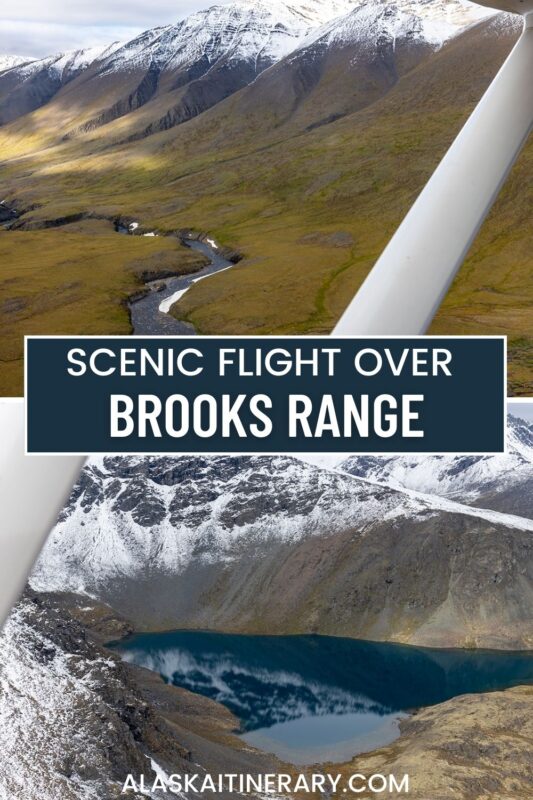
Embark on a Breathtaking Brooks Range Scenic Flight

If you’ve ever dreamed of flying above Alaska’s remote Brooks Range, this guide will help you plan every detail of that unforgettable experience. From choosing the right air taxi to knowing the best time of year to go, we’ve got you covered. Our recent flight over the northernmost mountain range in the United States left us absolutely awe-struck. The rugged peaks, endless tundra, and untouched wilderness from above were unlike anything we’d ever seen — and we’re excited to share our insights, tips, and photos from this incredible Arctic adventure.

Our Personal Experience with a Brooks Range Flightseeing Adventure
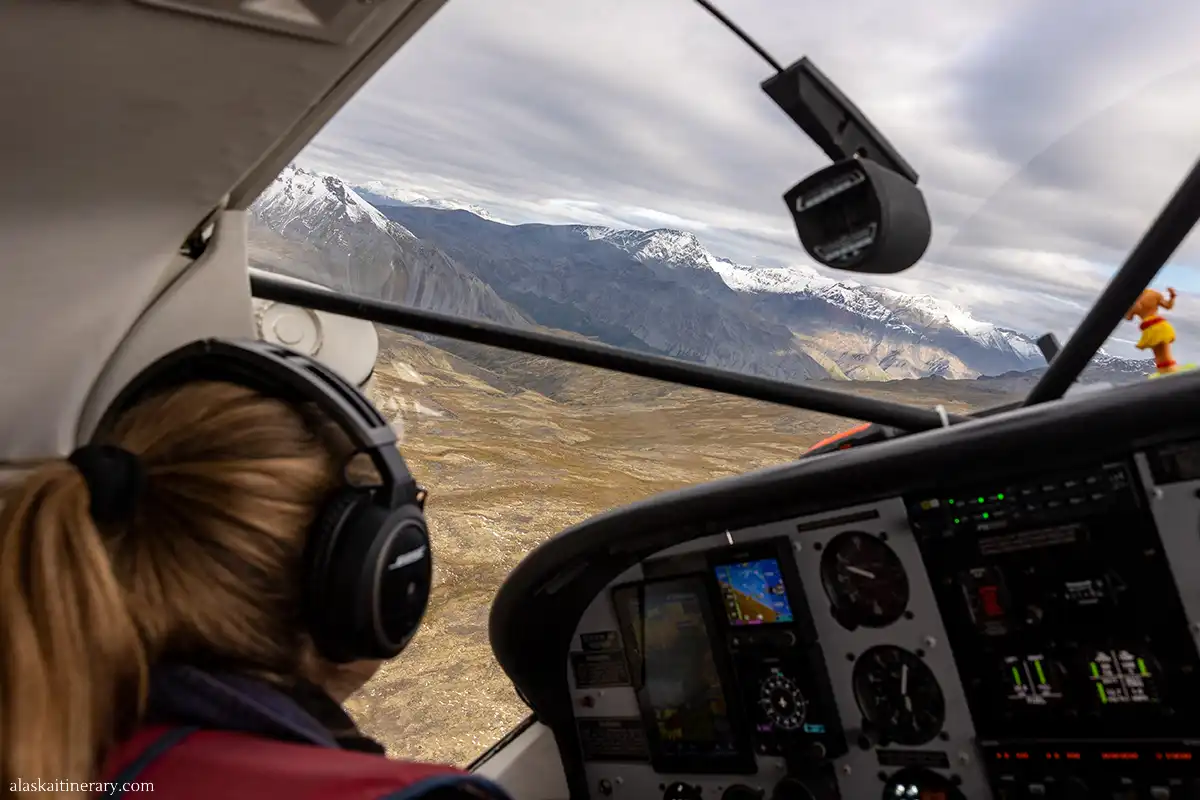
One of the best things to do in Alaska is flightseeing. In this article, we’re sharing our firsthand experience and practical tips from our scenic flight over the Brooks Range — one of the highlights of our journey along Alaska’s Dalton Highway. We flew with the incredibly skilled pilot Danielle from Coyote Air, based at Coldfoot Airport.
This post isn’t sponsored in any way. We paid for the trip ourselves and are sharing our honest impressions, travel tips, and photos from the flight — all captured during our Arctic adventure.
Alaska’s landscapes have always captivated us. Over the years, we’ve experienced several unforgettable flights — including a glacier landing in Denali National Park and a breathtaking bear-viewing flight in Katmai National Park.
Yet, our flight over the Brooks Range and Gates of the Arctic National Park was something entirely different — more remote, raw, and untouched than anything we’d seen before.
From above, the scale of this wilderness is humbling — endless peaks, winding rivers, and tundra stretching beyond the horizon. Join us as we take you through this once-in-a-lifetime journey and share insights to help you plan your own Brooks Range flightseeing adventure.
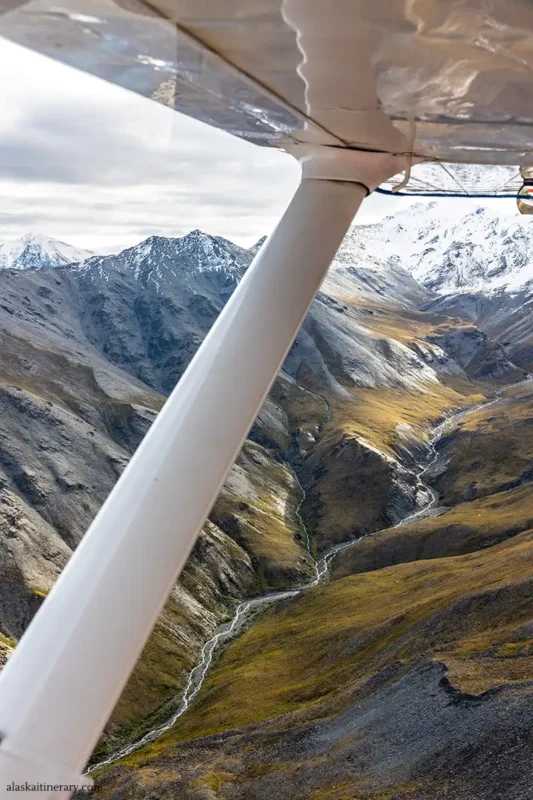

Discovering the Majestic Brooks Range: Essential Facts
Grasping the sheer scale, wilderness, and vastness of the Brooks Range requires an understanding of its significant aspects. Named in 1925 in honor of Alfred Hulse Brooks, the chief geologist of the U.S. Geological Survey in Alaska from 1903 to 1924, these mountains hold a storied place in Alaskan geography.
The Brooks Range is a region characterized by its sparse settlements, including the Alaska Native villages of Anaktuvuk and Arctic Village, as well as the communities of Coldfoot, Wiseman, Bettles, and Chandalar.
Geographical Highlights
- Location and Extent: Known as Gwazhał in Gwich’in, the Brooks Range proudly stands as the northernmost mountain range in the United States. Located in the American Arctic, it spans 700 miles (1,100 km) from west to east, stretching from northern Alaska into Canada’s Yukon Territory.
- Geographical Placement: Predominantly situated within the North Slope Borough, this mountain range lies almost entirely north of the Arctic Circle. It’s nestled to the south and east of the Arctic Ocean, including the Beaufort Sea and the Chukchi Sea, near Prudhoe Bay, which is especially noticeable if traveling via the Dalton Highway.
- Notable Peak: Mount Isto, the range’s highest peak at 8,976 feet (2,736 m), boasts an impressive geological history dating back 126 million years.
- Economic Significance: On the far west, near Kotzebue, lies the Red Dog Mine, the world’s largest zinc mine, which has been operational since 1989.

Key Highlights of the Brooks Range: Parks, Preserves, and Refuges
The Brooks Range is not just a series of mountains; it encompasses a range of significant national parks, preserves, monuments, and wildlife refuges. These include:
- Gates of the Arctic National Park and Preserve: Known for its rugged beauty and remote wilderness. (For tips on planning a trip to the Gates of the Arctic, stay tuned for our detailed guide.)
- Kobuk Valley National Park: A hidden gem offering unique landscapes and rich cultural history.
- Arctic National Wildlife Refuge: A haven for wildlife and natural beauty in the far north.
- Ivvavik National Park and Vuntut National Park: Located in Canada’s Yukon Territory, these parks are known for their pristine landscapes and diverse ecosystems.
- Selawik National Wildlife Refuge: A crucial habitat for a variety of Arctic wildlife.
- Noatak Wilderness and Noatak National Preserve: Offering some of the most undisturbed ecosystems in the Arctic.
- Cape Krusenstern National Monument: A historic and cultural landmark with archeological significance.
It’s important to highlight that among the eight national parks in Alaska, two are nestled within the Brooks Range. These parks are among the least visited in the United States, primarily due to their challenging accessibility. This remoteness adds to their allure, making a Brooks Range flightseeing tour an extraordinary opportunity to witness these untouched landscapes.


Diverse Wildlife and Unique Vegetation
The Brooks Range is a sanctuary for a diverse array of wildlife. It is home to polar bears, wolves, grizzly bears, Dall’s sheep, foxes, and snowshoe hares. This range also serves as a crucial migration route for numerous large herds of caribou. The vegetation here, shaped by the arctic climate, mainly consists of grasses, shrubs, alpine tundra, and sedges.
Notably, the treeline is situated in the southernmost part of the range, approximately 300 miles north of Fairbanks, marking a distinct ecological boundary.
Weather Patterns and Their Impact
The climate of the Brooks Range is surprisingly arid compared to other Alaskan mountain ranges located further south and closer to the coast. While these southern ranges can receive up to 250 to 500 inches of snowfall, the Brooks Range has a more modest average snowfall ranging from 30 to 51 inches.
At Anaktuvuk Pass, summer temperatures typically reach highs of 61°F (16°C) and lows of 37°F (3°C). In contrast, winter brings harsher conditions, with average highs around -8°F (-22°C) and lows plummeting to -22°F (-30°C).
Our own experience with the weather was a testament to its unpredictability. Our initial sightseeing flight was postponed due to adverse weather conditions, making it unsafe to fly. Fortunately, a few days later, we were graced with excellent weather, offering us spectacular views.
This variability is a hallmark of Alaskan weather, so we advise packing accordingly for your Alaska road trip, keeping in mind the sudden and often surprising changes in conditions. Also, if you plan to explore the Brooks Range, consult your plans with the Arctic Interagency Visitor Center.


Planning Your Brooks Range Scenic Flight: A Step-by-Step Guide
Arranging Your Flightseeing Experience with Coyote Air
For our breathtaking journey over the Brooks Range and visit to the Gates of the Arctic National Park, we chose Coyote Air, a small Alaskan company operating out of Coldfoot Airport. Their flightseeing season runs from June 1st to September 15th, during which they offer tours over the Brooks Range, Gates of the Arctic National Park, and Kobuk Valley National Parks.
To book your adventure, visit their official website. Based on our experience, detailed in our review, we can vouch for their professionalism, enthusiasm, and expertise in navigating this part of the Alaskan wilderness.
Our Tip for Travelers: Getting to Coldfoot is an adventure in itself. Located at milepost 175 on the rugged Dalton Highway, it’s a 254-mile journey from Fairbanks. Usually, it takes at least 6 hours without stops. Before embarking on this drive, be sure to read our safety tips for navigating the Dalton Highway. Check also suggestions for camping along the route. We recommend spending the night before your flight in Coldfoot or at the nearby Marion Creek Campground, just as we did.
Our scenic flight over the Brooks Range was an unforgettable experience, lasting over an hour. Words hardly do justice to the awe-inspiring beauty and grandeur of the mountains Chris and I witnessed.
To share a glimpse of what we saw and felt, we’ve included some photos and a short video from both our Brooks Range scenic flight and our visit to the Gates of the Arctic National Park.
Scenic Flights from Fairbanks and Bettles Field
For those seeking alternative ways to experience the Alaska Arctic from the skies, there are several other operators to consider. While we have not personally used these services and therefore cannot offer a direct evaluation or recommendation, we can provide some insights into your options.
- Air Arctic: Based in Fairbanks, Air Arctic Charter offers scenic flights that explore the expanse of the Brooks Mountain Range.
- Brooks Range Aviation: Operating out of Bettles since 1987, Brooks Range Aviation specializes in custom trips in the Arctic Region of Alaska. It’s important to note that Bettles is primarily a fly-in-only town, accessible by road only in late winter. They focus on transporting backpackers, rafters, hunters, researchers, and sightseers into the Brooks Range.
Our Tip for Efficient Travelers: If you’re short on time or if driving the challenging Dalton Highway isn’t feasible for you, a flightseeing trip from Fairbanks is a great alternative. This option allows you to experience the stunning vistas of the route from a unique aerial perspective.

Frequently Asked Questions
Does anyone live in the Brooks Range, Alaska?
People have lived in and around the Brooks Range for tens of thousands of years. The range is home to Alaska’s Native, including the Athapaskan, Iñupiat, Gwich’in, Koyukon, and Nunamiut.
What is the highest point in the Brooks Range?
Mount Isto, with an elevation of 8,976 ft (2,736 m), is the highest peak in the Brooks Range. It’s located in the Arctic National Wildlife Refuge in the Romanzof Mountains. 5 miles (8 km) south of Mount Hubley, the second-highest peak in the range.
Is the Brooks Range the same as the Alaska Range?
No. This range is separated from the Alaska Range, which lies to the south by the plains and plateaus of the Yukon and Porcupine River systems.
Can you drive to the Brooks Range?
The Brooks Range has no road access. You can get there by air taxi. The only road along the Brooks Range is 414 miles long, Dalton Highway. It stretches north of Fairbanks, crosses the Arctic Circle, and runs through Atigun Pass to Prudhoe Bay on the coast of the Arctic Ocean.
How do I get to the Brooks Range?
The best idea is to get an air taxi from Coldfoot Airport on milepost 175 of Dalton Highway. Another option is taking an air taxi from Fairbanks.
Are there polar bears in the Brooks Range?
Polar bears live along the North Slope of Alaska, the region of coastline north of the Brooks Mountain Range, in the Arctic National Wildlife Refuge. Alaska communities, Kaktovik and Utqiagvik (Barrow), offer limited opportunities for polar bear viewing.
Do You Like It? Pin It For Later!