
Russian Colonization of Alaska: A Simple Timeline

Alaska’s story is older than the United States, and part of it is deeply tied to Russia. The Russian Colonization of Alaska is a fascinating chapter of North American history. For over a century, Russian explorers, traders, and settlers crossed the Bering Sea to hunt, trade, and establish communities along Alaska’s rugged coast. Their influence shaped local economies, cultures, and even the region’s geography. This simple timeline walks you step by step through how Russia claimed, governed, and eventually sold Alaska to the United States. You’ll learn when key settlements began, how the fur trade transformed the land, and why the sale took place.
This article may contain affiliate / compensated links. For full information, please see our disclaimer here.
What This Timeline Covers
Understanding Alaska’s Russian colonial history helps explain many place names, cultural influences, and settlement patterns that still shape Alaska travel today.
I decided to write this article because I love history and facts. Today, the internet is flooded with false information, and it’s often hard to verify sources.
One of the most fascinating—and sometimes controversial—facts about Alaska is its connection to Russia. I want to share a clear timeline and reliable facts to help you better understand this chapter of history.
This timeline focuses on the key events of the Russian Colonization of Alaska, from the first recorded Russian sighting of its shores to the transfer of the territory to the United States. It traces the roots of the story, beginning with Russia’s expansion into North America, and focuses especially on Alaska.
You’ll see when Russian America was formally established, how settlements and trading posts developed, and how the fur trade shaped its economy. It also covers interactions between Russians, Alaska Natives, and other foreign powers.
Finally, it explains the events leading to the sale of Alaska in 1867. I also have a detailed article about the Alaska Purchase, but here we focus on the earlier history that set the stage for it. Each date is presented in clear, simple language so you can follow the story step-by-step.


Was Alaska Russian?
People often say “Alaska was Russian,” but the reality is more complex. From 1799 to 1867, much of Alaska was part of Russian America, a colonial territory managed by the state-sponsored Russian-American Company. It was never an integral part of Russia as a political entity, but rather a distant possession claimed for the fur trade and limited settlement.
Russian presence was concentrated in a handful of locations, including Sitka, Kodiak, and a few remote trading posts. The Russian population remained small — between about 400 and 832 individuals, with the peak reached in 1839. Most of the land was never under direct Russian control and remained the homelands of Alaska Native peoples.
In 1867, the United States purchased Russian America in what became known as the Alaska Purchase, ending nearly seven decades of Russian colonial rule.
With this context in mind, let’s walk through a simple, fact-based timeline of Russian colonization in Alaska and see how this history unfolded.

Alaska’s Geography: Why Russia Looked East
How Close Are Alaska and Russia? Alaska and Russia are much closer than many imagine. At their nearest point, only about 55 miles (88 kilometers) separate the two countries.
In the middle of the Bering Strait lie the Diomede Islands — Little Diomede (U.S.) and Big Diomede (Russia) — which are only about 2.4 miles (3.8 kilometers) apart.
The International Date Line runs between them, meaning the two islands are not only in different countries but also nearly a full day apart in time.
In winter, sea ice can sometimes connect the two, though crossing is not legal without permission. This short distance helped make Russian exploration and later colonization of Alaska possible.

Pre-Colonization Context: Alaska Before Russian Contact
Before Russian explorers arrived, Alaska was home to diverse Indigenous peoples. These included the Aleut (Unangan), Yup’ik, Inupiat, Tlingit, Haida, Athabaskan, and others.
Each group had its own language, culture, and traditions. They lived in harmony with the land and sea, relying on fishing, hunting, and gathering.
Coastal communities thrived on salmon, seals, and whales. Inland groups hunted caribou, moose, and other game. Trade networks connected distant regions long before European ships appeared. Goods such as furs, copper, and shells moved between villages across hundreds of miles. Spiritual beliefs were tied to nature and seasons.
The arrival of Russians in the 18th century would bring drastic changes to these established ways of life.

1728–1741: The Kamchatka Voyages
In 1728, Danish navigator Vitus Bering, sailing for the Russian Empire, left the Kamchatka Peninsula on the First Kamchatka Expedition. His mission was to determine whether Asia and North America were connected by land. Sailing north through what is now the Bering Strait, he saw no sign of the American coast before turning back due to weather and ice.
A second, larger expedition—the Great Northern Expedition—set out in 1741. Bering commanded the St. Peter, while Aleksei Chirikov captained the St. Paul. In July 1741, Chirikov sighted land in what is now Southeast Alaska. He sent men ashore, but they never returned, likely killed in conflict with local Tlingit people.
Days later, Bering reached the Alaskan mainland near present-day Kayak Island. His crew went ashore, documenting plants, animals, and the native peoples they encountered. German naturalist Georg Wilhelm Steller, aboard the St. Peter, recorded the first scientific descriptions of Alaska’s wildlife, including the Steller sea lion and the now-extinct Steller’s sea cow.
The return journey was disastrous. Bering fell ill and died on what is now Bering Island. Survivors, including Steller, managed to build a small vessel from the wreckage and sailed back to Kamchatka in 1742. Despite the hardships, these voyages produced the first detailed European maps and descriptions of Alaska, paving the way for future Russian ventures.
1740s–1780s: Fur Hunters Arrive
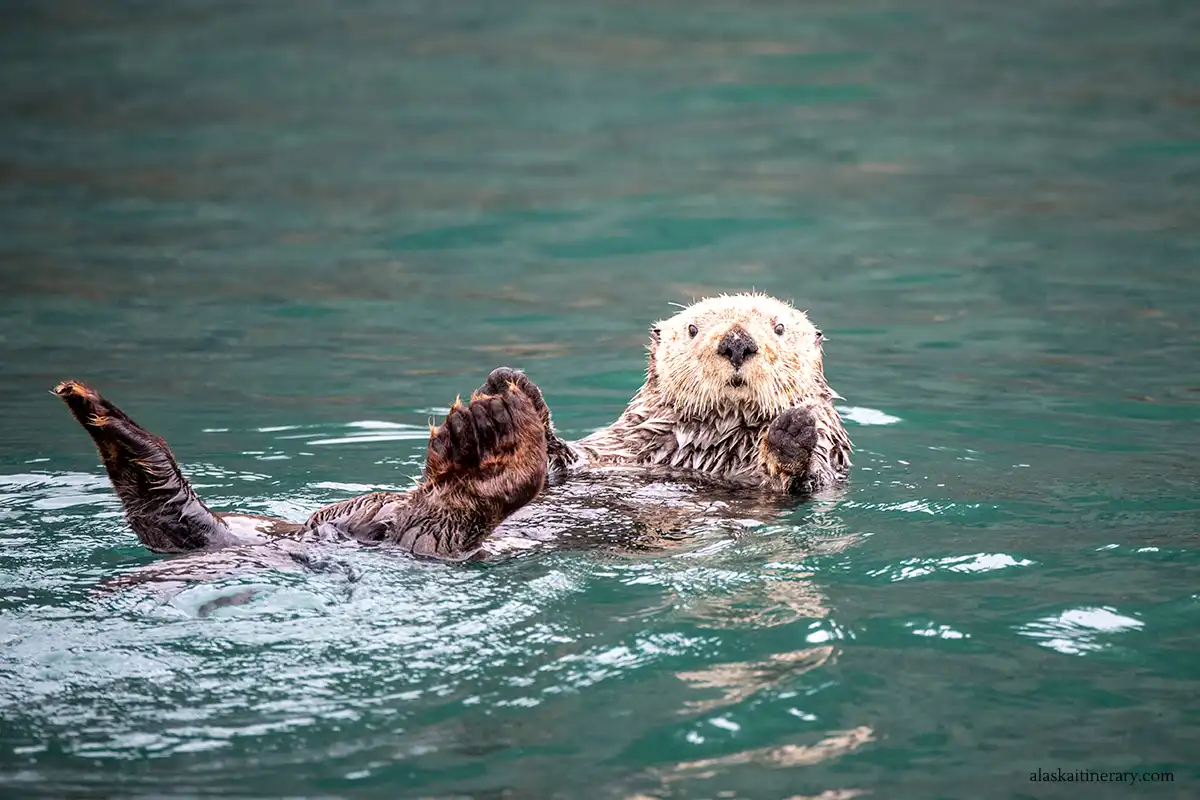
After Bering and Chirikov’s voyages, word of rich sea otter populations spread quickly in Siberia. Russian promyshlenniki—seasonal fur hunters and traders—pushed east from Kamchatka across the Aleutian Islands. Their main target was the sea otter, prized in China for its dense, glossy fur.
At first, these were small, seasonal expeditions. Crews lived on their vessels and set up temporary shore camps to hunt and process pelts. By the mid-1700s, the trade intensified. Hunters began staying longer, establishing semi-permanent posts in the Aleutians.
This expansion came at a cost. Competition for furs led to overhunting and sharp drops in sea otter numbers. Relations with Indigenous Unangax̂ communities grew tense. Some Russians forced local men to hunt under threat, while others took hostages to secure cooperation. Armed resistance and violent clashes were not uncommon.
By the late 1780s, the Aleutian chain had become a vital fur-trade corridor linking Siberia to markets in China via Kyakhta. The groundwork for permanent Russian settlement in Alaska was set.
1784–1798: First Permanent Colony
The first permanent Russian settlement in Alaska began in 1784, when merchant Grigory Shelikhov established Three Saints Bay on Kodiak Island. He arrived with ships, supplies, and armed men, aiming to control the sea otter trade and expand Russian influence. This settlement marked a turning point from seasonal hunting camps to a year-round colonial presence.
Life in the colony was harsh. Winters were severe, food was often scarce, and relations with the Alutiiq (Sugpiaq) people were tense. Russian traders used both negotiation and force to secure labor and pelts. The site became the administrative and commercial hub of Russian operations in the region.
In 1792, a powerful earthquake and tsunami damaged much of Three Saints Bay. The main settlement moved north to what is now the city of Kodiak. Under the leadership of Alexander Baranov, who arrived in 1790 as Shelikhov’s manager, the colony grew stronger. Baranov expanded trade networks, built infrastructure, and began consolidating control over coastal Alaska, setting the stage for the formal creation of the Russian-American Company in 1799.

1802–1808: War and a New Capital
The early 1800s marked Russia’s bold push into Southeast Alaska. In 1799, Alexander Baranov, governor of Russian America, ordered the construction of a small outpost called Redoubt St. Michael at Sitka (today called Old Sitka). This location, deep in Tlingit territory, offered access to rich sea otter hunting grounds.
The Tlingit, determined to defend their homeland, attacked in June 1802. They destroyed the outpost, killed most of its inhabitants, and forced survivors to flee by ship to Kodiak. Baranov returned in 1804 with a heavily armed force of Russian promyshlenniki, Aleut hunters, and the warship Neva.
The ensuing Battle of Sitka was the largest military engagement in Alaska’s colonial history. After several days of fighting and heavy cannon fire, the Tlingit withdrew, but they were never fully subdued. In 1808, Baranov made the rebuilt settlement—now named Novo-Arkhangelsk—the capital of Russian America.
From this fortified coastal hub, the Russian-American Company managed trade, diplomacy, and expansion for the rest of the colonial period. Sitka would remain the administrative and cultural center of Russian Alaska until the 1867 transfer to the United States.

1812–1825: Southward Expansion and Boundaries
The Russian-American Company sought new ways to supply Alaska. Harsh winters and poor farming made food scarce. Transport from Siberia was slow and costly.
In 1812, Russians established Fort Ross on the coast of California. This settlement, north of San Francisco, was part of the wider Russian colonization of North America. It supplied grain, produce, and livestock to Alaska and supported sea otter hunting in nearby waters. Fort Ross also enabled trade with Spanish California and foreign ships.
At the same time, Russian influence stretched south along the Pacific Northwest. Company traders operated in what is now British Columbia. This expansion brought them into conflict with Britain and the United States.
In 1821, Tsar Alexander I issued a ukase (imperial decree). It claimed exclusive Russian rights to trade and fishing along much of the northwest coast. The decree also barred foreign ships from approaching within 100 Italian miles (about 115 modern miles) of Russian settlements.
The United States and Britain protested strongly. Diplomatic talks followed. The disputes ended with two treaties: the Russo-American Treaty of 1824 and the Russo-British Treaty of 1825.
The 1824 treaty set the southern boundary of Russian America with the U.S. at 54°40′ north latitude. The 1825 treaty with Britain defined the coastal strip of Russian America, now Alaska’s Panhandle. These agreements limited Russian claims and secured foreign access to trade.
1820s–1840s: Missions, Schools, and Change
The Russian-American Company was more than a trading enterprise. By the 1820s, it began shaping Alaska’s culture through religion and education.
The Russian Orthodox Church sent missionaries to settlements and Native villages. St. Herman of Alaska, a monk from Valaam Monastery, lived among the Unangax̂ and Alutiiq on Kodiak Island. He became known for helping orphans, protecting Native rights, and speaking against company abuses.
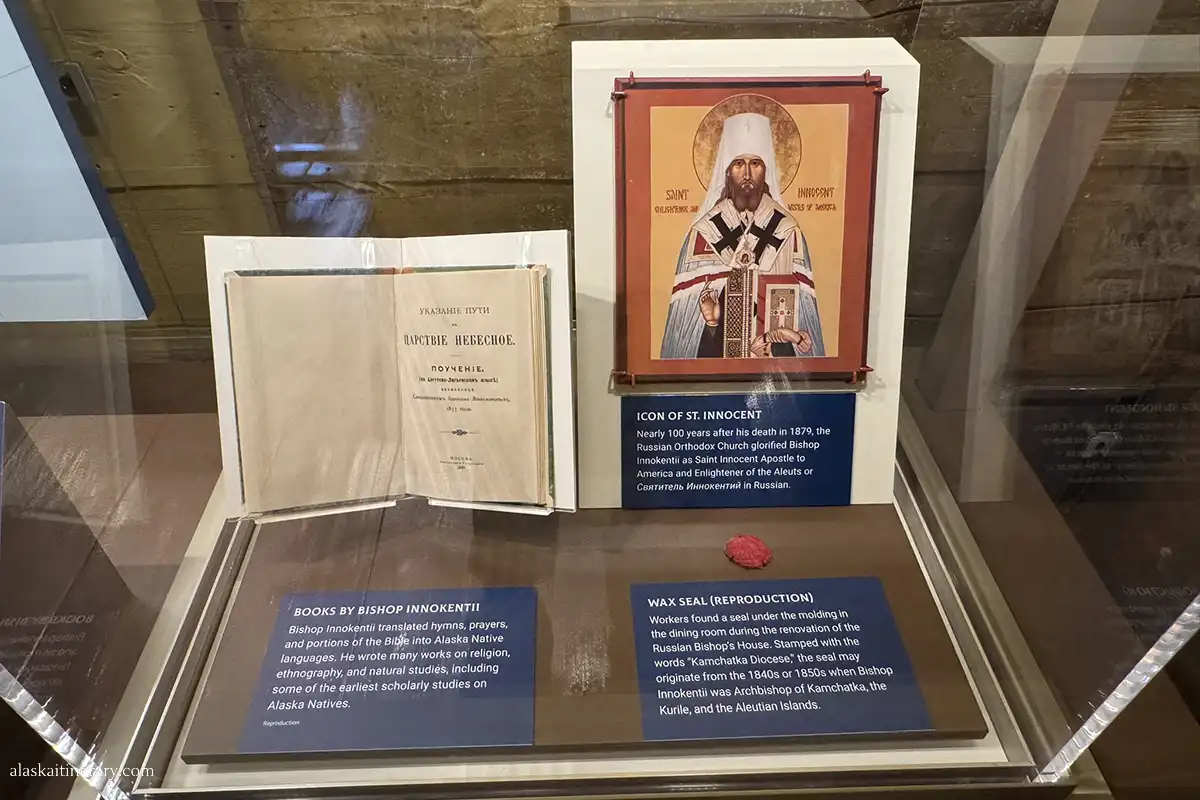
Later, St. Innocent (Ivan Veniaminov) arrived from Siberia in 1824. Fluent in multiple languages, he learned Aleut and Tlingit. He created alphabets for Native languages and translated religious texts. His work helped preserve these languages in written form.
Missionaries also built schools. Children learned reading, writing, and religious instruction. Some schools taught basic trades. These efforts left a deep mark, blending Russian culture with local traditions.
At the same time, life in Russian America grew harder for Indigenous peoples. Foreign diseases, especially smallpox and measles, spread quickly. Populations declined sharply. Russian settlements also changed traditional hunting and fishing patterns, causing food shortages.
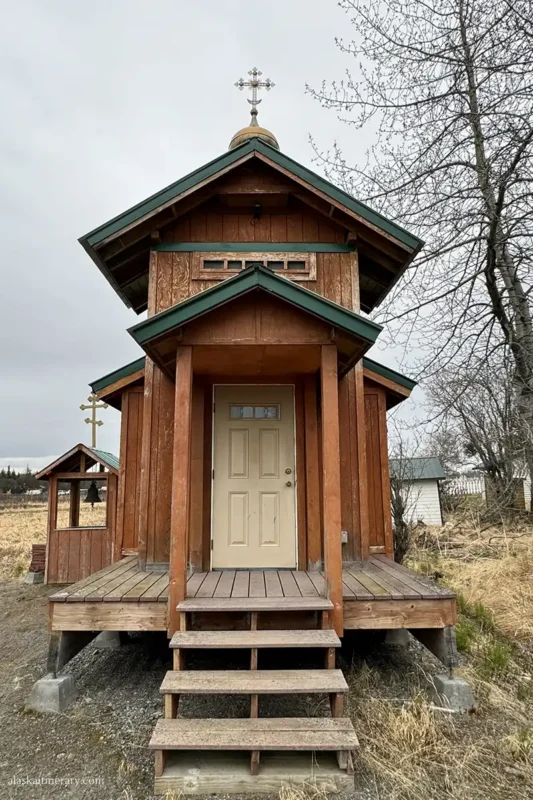
Despite hardships, many Native communities blended new religious practices with older beliefs. The Orthodox Church remains active in Alaska today, with historic churches in places like Kodiak, Sitka, Kenai, and Ninilchik still in use.
1830s–1860s: Decline of the Fur Empire
By the 1830s, the wealth of Russian America was fading. The sea otter, the colony’s most valuable resource, had been hunted almost to extinction. Overharvesting in the Aleutians and along Southeast Alaska’s coast left few animals to support the fur trade.
The Russian-American Company struggled to stay profitable. Supply lines from St. Petersburg were long and costly. Ships took over a year to make the round trip. Food and goods often arrived late or spoiled.
The Crimean War (1853–1856) deepened the colony’s troubles. Russia diverted resources to Europe, leaving Alaska underfunded and poorly defended. British naval forces threatened Russian outposts in the Pacific.
By the late 1850s, competition from British and American traders grew. Whaling ships brought new goods and alternative trade to Alaska Native communities. The company’s monopoly weakened.
At the same time, Native resistance and cultural resilience continued. Tlingit communities maintained control over key trade routes and resisted Russian encroachment. The costs of maintaining forts, paying workers, and transporting goods outweighed profits from the declining fur harvest.
By the 1860s, Russian leaders saw Alaska as a liability. Selling the territory became a practical solution to avoid losing it in a future war and to recover some value from the struggling colony. This set the stage for negotiations that led to the Alaska Purchase in 1867.

1867: The Alaska Purchase
On March 30, 1867, Russia and the United States signed the Treaty of Cession. U.S. Secretary of State William H. Seward and Russian envoy Eduard de Stoeckl negotiated the deal for $7.2 million—about two cents per acre.
The transfer ceremony took place in Sitka on October 18, 1867. Russian troops lowered their flag, and U.S. soldiers raised the Stars and Stripes over the capital. More details are available in my article: Alaska Purchase.
For Russia, the sale ended decades of costly colonial operations. For the United States, it was a strategic move, gaining valuable resources and a Pacific foothold.
During the Russian colonization of Alaska, the number of Russian settlers remained small—ranging from about 400 to 832 individuals, with the peak reached in 1839. Even by the time of the 1867 Alaska Purchase, only about 2,500 people of Russian or mixed Russian-native descent lived under Russian administration.

What Changed After 1867
After the Alaska Purchase, control shifted from Russia to the United States. The U.S. military governed Alaska at first, replacing Russian officials. New American laws and trade systems were introduced. Many Russian institutions disappeared, but the Russian Orthodox Church remained active.
Churches in places like Sitka, Kodiak, and Ninilchik continued to serve local communities. Trade moved toward American markets, and the focus shifted from fur to fishing, mining, and other industries.
Final Thoughts
The Russian colonization of Alaska left a lasting mark on the state’s history, culture, and place names. From early fur traders and the establishment of Sitka as the colonial capital to the expansion of settlements along the Pacific coast, this era shaped Alaska’s identity long before it became part of the United States.
The period also brought profound changes to the lives of Alaska’s indigenous peoples, whose traditions and knowledge remain an essential part of the region’s heritage today.
The number of Russian settlers remained small—between about 400 and 832 individuals, with the peak reached in 1839—but their presence brought profound changes to Alaska’s indigenous peoples.
Understanding this chapter of history offers valuable insight into Alaska’s unique story and its path toward the 1867 Alaska Purchase.
Do You Like It? Pin It For Later!


I had no idea about much of this history, so it was really interesting to read. It’s not always easy to understand just how close Alaska and Russia are when you see the map this way. I love the look of all the old churches, but what I thought was most interesting was the sale price. Hard to even imagine land being 2 cents per acre though
Thanks for the very timely post with the details and timeline of the Alaska-Russia relationship. Despite studying US History, this area was not heavily covered.
Interesting post, I had not been aware of this before reading the post. It always fascinates me when colonialising countries do things to try and ‘help’the country they have colonalised.
I only realised Alaska was once part of Russia after the recent media coverage of the Trump/Putin meeting in Alaska, so this post has been an interesting read and explained all the questions I was asking.
This is FASCINATING! A part of history I truly knew nothing about. So glad I found your breakdown!
Wow, what a detailed guide! I have never known how many different indigenous people lived in Alaska. It would be interesting to know a bit more about their culture, but probably, it is not so much to be preserved since then. Or am I wrong?
For more information on Alaksa Native culture look up Alaska Native History Cultural Center (ANHC). We have a very rich culture in Alaksa.
What an insightful overview of Alaska’s Russian colonial past! This is super timely especially because I only just discovered a week go that Alaska used to “belong” to Russia, so stumbling upon this gave me so much more nuance to the history!