
Sitka’s Russian Heritage: History, Battle, Landmarks & Museums

Sitka may be a small Alaskan town, but its history is anything but. Once known as New Archangel, it was the capital of Russian America and the site of one of the most important battles in Alaska’s colonial past. Today, traces of Russian influence in Sitka are everywhere—from onion-domed churches to old Russian homes and forts. If you’re curious about Russian America, colonial expansion, or Indigenous resistance, Sitka is the place to explore it all. This article dives into Sitka’s layered past: the Battle of Sitka, historic landmarks, Russian Orthodox heritage, and the museums that preserve it all.
This article may contain affiliate / compensated links. For full information, please see our disclaimer here.
Why Sitka’s Russian History Still Resonates
Sitka looks quiet today, but its past tells a different story. In the early 1800s, it was the center of Russian America. Russian settlers clashed with the local Tlingit people. Empires expanded. Cultures collided.
The influence of that era remains. You’ll see it in the buildings, museums, and street names. But more than anything, you’ll feel it in the layered stories this town still holds.
Sitka isn’t just a scenic Alaska cruise port. It’s where Russia’s presence in North America once peaked. It’s where Indigenous resistance made history. And it’s where the United States later took possession of Alaska in a quiet, symbolic ceremony.
I’ve always been passionate about history and love digging into facts and numbers behind each place we visit. During our first Inside Passage cruise, when Chris and I stepped off the ship in Sitka, I was amazed by how many traces of Russian influence still shaped the town.

We joined a couple of local shore excursions to learn more—and quickly realized that one day in Sitka isn’t enough to see it all. Since then, we’ve returned on several cruises, taking time to explore more of Sitka’s Russian heritage. Now I’m excited to share what we’ve discovered with you.
This guide explores that complex legacy. We’ll take you through the key moments of Sitka’s Russian past. You’ll find out where the most important events happened. And you’ll learn what to see if you want to walk through this fascinating chapter of Alaskan history—while exploring Sitka’s downtown on your own, or on a tour.
Add discovering Sitka’s rich Russian history to your Alaska cruise bucket list—you won’t regret it.


New Archangel: From Tlingit Village to Russian Capital
Long before Russian ships arrived, Sitka was home to the Tlingit people. They called the area Sheetʼká, meaning “people on the outside of Shee.” Shee was the name for Baranof Island, where Sitka now sits. Their main village, Shee Atiká, sat near the sheltered waters of Sitka Sound.
This rich land offered plenty of resources—fish, game, timber, and protected bays. Tlingit clans thrived here for centuries. But in the late 1700s, everything began to change.
In 1799, Russian traders arrived, led by Alexander Baranov of the Russian-American Company. They were drawn by the sea otter trade. Sea otter pelts were incredibly valuable in China and Europe.
At first, relationships between Russians and Tlingit were tense but somewhat cooperative. Trade took place. But Russian expansion soon threatened the Tlingit way of life. In 1799, the Russians built a fort called Redoubt St. Archangel Michael near the Tlingit village. That act sparked deep resistance.

In 1802, the Tlingit attacked and destroyed the Russian outpost. Many settlers died. The survivors fled to Kodiak. It was a bold act that showed the Tlingit would not be pushed aside easily.
But Russia wasn’t finished. In 1804, Baranov returned with warships and reinforcements. That clash became known as the Battle of Sitka.
After that battle, Russia took control of the region. In 1808, the town became the capital of Russian America. They named it New Archangel—after Arkhangelsk, a Russian city on the White Sea. It became the largest and most important settlement in Russian Alaska.
From this base, Russians built homes, schools, churches, and warehouses. They governed trade and religion from Castle Hill, where the Tlingit village once stood. The Russian Orthodox Church also took root here, leaving behind landmarks still visible today.


The Battle of Sitka (1804): Clash That Shaped the Region
The Battle of Sitka was the last major conflict between Russian settlers and Alaska Natives. It took place in October 1804 and changed the future of the region.
After the Tlingit destroyed the first Russian fort in 1802, the Russians waited and regrouped. Two years later, Alexander Baranov returned. He came with a fleet of ships, cannons, and around 150 Russian and Aleut fighters.
By then, the Tlingit had built a strong new fort near the mouth of the Indian River. They were ready to defend their land. The Russian warships anchored nearby. For several days, they bombarded the Tlingit fort with cannon fire.

The Tlingit, led by Chief Katlian, fought hard. But they were outgunned. Their gunpowder supply was limited. On the fourth night, they made a strategic retreat into the forest. They didn’t surrender—they simply moved to protect their people.
This conflict marked the end of open fighting. But it did not end Tlingit resistance or pride.
After the Tlingit retreated, Russians claimed the land and built a new fort on Castle Hill. This became the heart of Russian power in Alaska. From there, Sitka grew into the capital of Russian America.
Today, you can walk the battlefield in Sitka National Historical Park. The park trail leads to the old fort site. Interpretive signs along the way tell the story. The forest is peaceful now, but the history is still alive.
This battle was a defining moment. It shaped the identity of Sitka and left a lasting mark on Alaska’s past.

From Russia to America: The 1867 Transfer Ceremony in Sitka
But by the 1860s, the fur trade had slowed. Russia, facing financial and political pressure, decided to sell Alaska.
Sitka played a central role in one of the most significant moments in Alaska’s history—the transfer of power from Russia to the United States. On October 18, 1867, a formal ceremony was held on Castle Hill, the seat of Russian authority in Alaska.
During this symbolic event, the Russian flag was lowered, and the American flag was raised in its place. The ceremony marked the official purchase of Alaska by the United States for $7.2 million, a transaction negotiated by U.S. Secretary of State William H. Seward.
At the time, Sitka became the first capital of the new American territory. The town quickly shifted from a Russian colonial hub to a remote outpost under U.S. military control.
Over the next few decades, Sitka’s importance declined as the territorial capital was moved to Juneau in 1906, and many Russian settlers returned to their homeland or moved elsewhere.
Today, Alaska Day is still celebrated every October 18 in Sitka, with a reenactment of the 1867 ceremony held on Castle Hill—reminding locals and visitors alike of Sitka’s key role in this dramatic change in ownership.

Key Russian Landmarks in Sitka
Walk through Sitka, and you’ll feel like you’ve stepped back into a different era. The town is filled with traces of its Russian past. These landmarks aren’t just buildings—they’re living history.
Here are some of the most important Russian-era sites you can explore on your visit. All those places are easy to explore in Sitka on your own.
St. Michael’s Russian Orthodox Cathedral
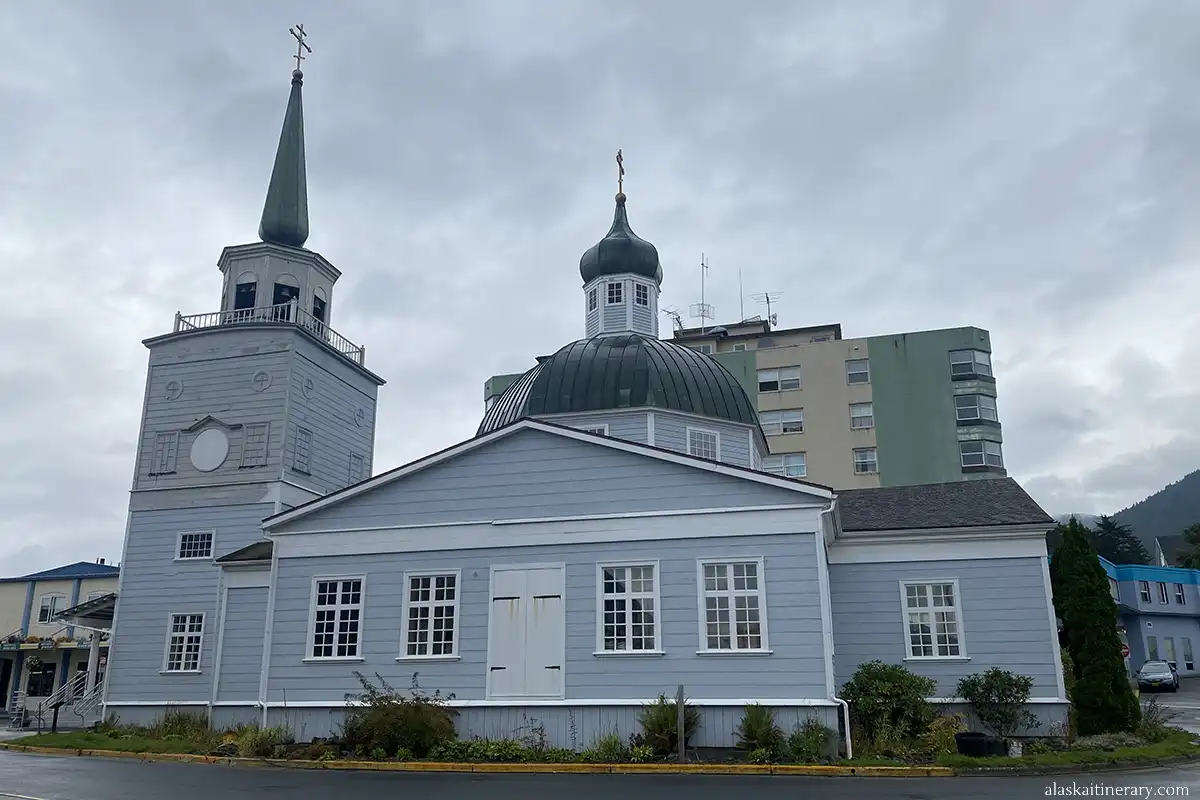
This iconic green-domed church stands in the heart of downtown Sitka. It was originally built in the 1840s as the first Russian Orthodox cathedral in North America.
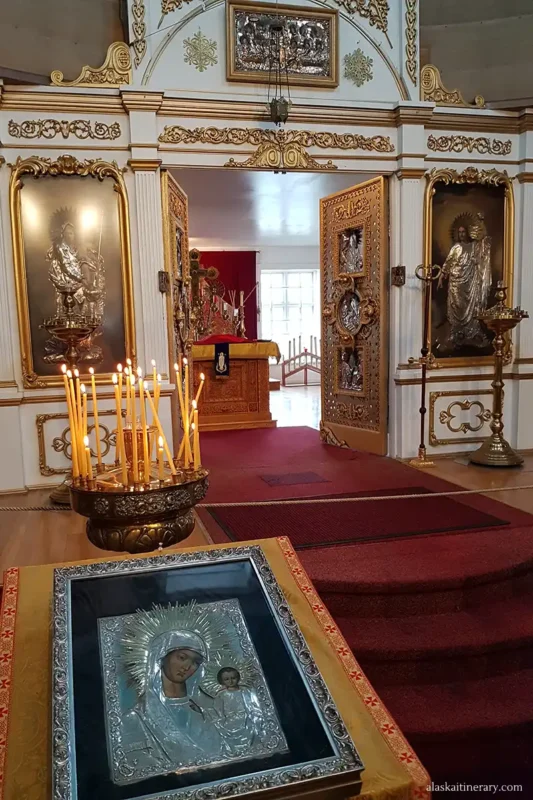
The current building is a careful reconstruction, as the original was destroyed by fire in 1966. Inside, you’ll find impressive icons, religious artifacts, and chandeliers brought from Russia.

Russian Bishop’s House
Operated by the National Park Service, this two-story log building was constructed between 1842 and 1843. It served as the residence of the Russian Orthodox bishop.
Today, it’s a museum offering guided and self-guided tours. You’ll see original floors, rooms, and religious items that help tell the story of Russian clergy life in Sitka.


Building No. 29 (The Russian-American Company’s Warehouse)
This log structure is one of the few surviving commercial buildings from the Russian colonial period. It was used to store goods brought from Russia and traded in Alaska. You can spot it across the street from Castle Hill, just a short walk from the harbor.
Castle Hill (Baranof Castle Site)
While the original Russian buildings are no longer standing, Castle Hill remains an important historical site. It’s where the 1867 transfer ceremony took place.
Today, you can walk up a short trail to enjoy panoramic views of Sitka and read informative signs about the Russian and American periods.


Sitka Lutheran Church
Though not Russian Orthodox, this church dates back to 1840 and was built by Finnish and German Lutherans who worked for the Russian-American Company. It’s considered the oldest Lutheran church on the Pacific coast of North America.
Old Russian Cemetery
Tucked away in the woods, this quiet cemetery holds the graves of early Russian settlers, including crewmembers, clergy, and local families. The crosses and moss-covered markers offer a reflective space and an often-overlooked link to the town’s early days.
Saint Jacob Netsvetov Memorial and Russian Blockhouse
Located near the old cemetery and the Holy Trinity Church, this memorial honors St. Jacob Netsvetov (1802–1864), Alaska’s first Native‑born Orthodox priest. Born to an Aleut mother and Russian father, he served throughout Alaska and passed away in Sitka .
The Orthodox Church and National Park Service are searching for his actual burial site—relics may one day be enshrined at St. Michael’s Cathedral .
Commanding the cemetery and church, a brick‑look blockhouse stands over the historic site. It’s a partial replica of the 1840s structure that protected Castle Hill and Holy Trinity Church. These blockhouses held small cannons to guard the town’s eastern gate during Russian rule .
The current one marks the edge of the old Russian settlement and echoes the town’s colonial military history .


Many of these landmarks are located in downtown Sitka and are easy to visit on foot. Exploring them gives you a strong sense of the deep Russian roots still shaping the city today.
Sitka’s Museums Worth Visiting to Learn About Russian Heritage
If you want to understand Sitka’s Russian past, these two small but fascinating museums are worth your time. Both are easy to visit on foot from the cruise port or downtown.
Sitka History Museum
This is the best place to explore Sitka’s Russian chapter in detail. The exhibits walk you through the town’s story—from Tlingit culture through Russian colonization to the American era.
You’ll find maps, photos, artifacts, and displays about the Russian-American Company, Castle Hill, the 1804 Battle of Sitka, and the 1867 transfer ceremony.

Sheldon Jackson Museum
While the focus here is on Alaska Native cultures, the museum also includes objects from the Russian colonial period. You can see items like Russian trade goods, religious artifacts, and pieces showing the interaction between Russians and Indigenous communities.
It’s a great complement to the Sitka History Museum if you want a broader cultural context.

Sitka’s Russian Heritage – Final Thoughts
Sitka surprised us. We knew about its Russian past, but seeing it in person made it feel real. From onion-domed churches to cannon-blasted hills, history is everywhere here.
If you’re curious about Alaska’s past, Sitka is one of the best places to visit. It’s walkable, beautiful, and packed with stories. We’ve explored Sitka during several Alaska cruises, and each time we’ve discovered something new.
Whether you visit on your own or take a shore excursion, don’t skip the landmarks. Learn about the Tlingit people, the Russian settlers, and how their worlds collided.
This is not just a small port town. It’s a place where Alaska’s complex story comes alive.
Do You Like It? Pin It For Later!


Sitka looks great, thanks for sharing the story, I love places where the historical background makes you travel in time!
Now I understand the history of Alaska, thanks to your brief but clear information. I also enjoy visiting and learning about local history wherever we go. The churches and buildings with Russian heritage will surely catch my attention. I wonder about the food, whether they still have Russian influence or not.
What a beautifully detailed guide to Sitka’s Russian heritage! I really appreciate how you’ve woven together the layered history — from the Battle of Sitka to the reconstructed architecture like St. Michael’s Cathedral and the Russian Bishop’s House. It’s such a poignant reminder of Alaska’s colonial past and the resilience of the Tlingit people. I especially love that you highlighted Sitka National Historical Park—walking in the forest and learning about what took place is, I can imagine, a moving experience. Thank you for sharing this insightful piece; I did not know much about Sitka, and reading this has inspired me to look deeper into Alaska’s lesser-known historical narratives.